
Is it possible to gain self-knowledge by studying a rat?
Fast, Cheap and Out of Control (1997) Dir. Errol Morris
un texto de Daniel C.

Ray Mendez is a scholar of the naked mole rat. Early in the movie, introducing himself, he tells us he belonged to an entomology club in school and that, twenty years later, a friend called him in the middle of the night, saying: “Ray, we found them.” He didn’t even have to explain. Ray knew exactly what he was talking about: a mammal which behaves like an insect: the naked mole rat, which lives under the earth, is incapable of regulating its own temperature, and whose society operates more like a termite colony than like any other community of mammals. He’s spent the rest of his life studying the animal, photographing it, and curating museum exhibits to let the public get to know it, too.
Just a moment…twenty years? He’d been waiting for that phone call for twenty years? We don’t even know what he did in those twenty years of his life, after school. It’s supposed to remain unexplained? If he’d been an entomologist all this time, he wouldn’t have told us he was simply a member of an entomolgy club in school. What was he, then? An accountant? A chauffeur? At least a kind of biologist? What made him drop everything and decide to study a rat?
An explanation is what seems to be missing in the choices for profession of these four subjects, each with totally different jobs, apparently unrelated in any way. A lion tamer, Dave Hoover, tells us he fell in love with that job after seeing another lion tamer as a child, named Clyde Beatty, who also appeared in movies (of questionable quality, he admits) and who became his hero. Rodney Brooks, who builds robots that walk and interact with their environment in an independent manner eerily resembling that of an insect, explains to us that he liked solving problems as a kid. George Mendonça, a topiary gardener who has cut trees in the shapes of animals in a park called Green Animals for over 40 years, inherited the job from his father-in-law. Pretty simple.
These are all unusual jobs. How did they end up in them? They might think they have an explanation, a reason, but in reality, the ostensible reason only adds to the mystery. The mystery of why someone gets obsessed with something, why someone ends up in one place rather than another, why someone chooses one hero and not another, why someone marries this person and not that one.

Brooks

Hoover

Mendonça

Mendez
Brooks, the roboticist, says that he likes taking a common belief and negating it. A mistaken supposition is, for example, that people tend to think that a robot has to come out fully formed, with purpose, with intentionality, while in reality the robot is simply constructed in such a way that it interacts with its environment and responds to it. The intentions form themselves. He doesn’t believe there can be such a thing as incorporeal intelligence. To a professor who once asked him how he tells the robot what to do, he answers: “you don’t tell the robot what to do. You just switch it on and it does what is in its nature.”
Just like people talk about the human brain as divided evolutionarily into the fish brain, the reptilian brain, and then the mammalian, precisely in such a way could more complex robots start to emerge, as their interactions with their environment and with their peers get more complex. The conclusion, which follows logically and which he can’t help but comment on, is that we are ourselves made of a series of “robots” making up a kind of Frankenstein monster, with each part doing its thing. The “I” in that case is just an illusion, but one in which he himself finds impossible not to fall back on, since without it life loses its meaning.
What meaning? For the lion tamer, this seems to be the complete absorption he feels when, he tells us, inside the cage he’s so concentrated that he really doesn’t know whether outside it are five spectators or five hundred. He clearly also loves adrenaline and he recounts to us with some pleasure all the times he’s been close to death. He even has recurring nightmares of a lion biting his head off from behind in one bite. For the gardener, meaning seems to reside in maintaining everything he’s constructed on the basis of hand scissors (while obstinately rejecting all mechanical tools) and that on his promise to the owner of the park to take care of it until the day he dies. After he dies, he can’t promise anything.
This owner, the gardener’s boss for most of his life, he introduces to us in one or two comments. No more. He tells us she would ask him to collect flowers for her once in a while, and that she always wanted to see the garden before any visitor came. He tells us she never married because there was only one man she wanted and it didn’t work out, so she decided never to marry. He mentions this quickly, but we want to know more. A lot more. Right away, we want to know who the man was, whether they had a relationship or if it was just some guy, whether he even gave a damn about her, this man who she decided to sacrifice her happiness for. Or maybe it was just an excuse for her to hide other things she didn’t feel comfortable revealing. Or, perhaps, one might wonder, was she even in love with him, or did she only remember it that way because it’s impossible to live life without telling yourself a story, without finding an explanation, a reason? To me, there’s more mystery in that little parenthesis than in a thousand detective novels put together. And yet, it’s a completely ordinary experience. In any life we might find mysteries of the same proportion, if we just looked for them.
Mendez says he studies rats not from a scientific point of view, but rather looking for self-knowledge. He wants to know what he can learn about himself by studying these rats which behave like insects. It’s a very poetic justification, but to me it sounds like precisely that, a justification. That’s what he wants to believe he sees in them, since he has to explain to himself why he became so obsessed with a rat. The truth is he doesn’t know. None of us knows why we do what we do. Self-knowledge is what we least have.
If someone is reading this (if they got this far) it’s probably out of some interest, possibly professional, in the arts. What led them to choose that profession? Was it a rational decision? In what moment did they decide on one thing and not the other? Or was there never a choice? If there never was, why? Everyone will have their explanation, and it will vary in depth depending on the person’s tendency to look for reasons. A shallow or a deeper explanation might be partly true, but even the deepest doesn’t really do more than scratch the surface.
Each time the camera cuts abruptly from one character to the other, which it does constantly, it’s somehow funny (at least for me). I think it’s because each time it makes us wonder what the relationship between these characters is. This remains a mystery. Perhaps it’s because these sudden cuts emphasize the absurdity of everything we do and the comedy produced by seeing each of us flailing around, looking for reasons when we’re really just switched on and we do what’s in our nature. In our case, our nature is to look for meaning in things and in life, to look for a reason.
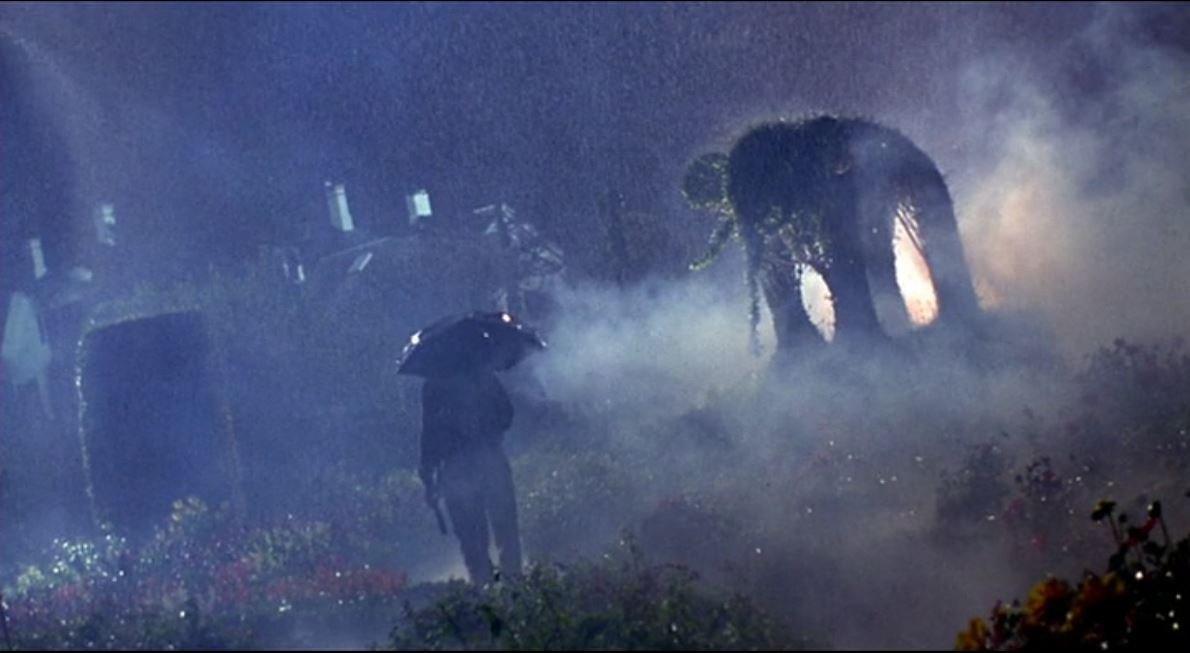
Above the comedy, if you can call it that, is the poetry. Intercut among the interviews of the characters (done in the manner particular to Morris’ interviews, where through his method he makes it so while the characters look at him they’re also looking straight to the camera, creating an enhanced intimacy) we have dramatic images, almost comically dramatic, of Mendonça working on his animals, illuminated against the dark night, or strolling around the garden with an umbrella and his scissors under the pouring rain. Or we have images of the circus, or of the robots walking around, or of the rats. All these images are accompanied by an orchestral music which alternates between cheerful and unsettling. Does a simple gardener deserve such a dramatic mise-en-scene? The only thing that occurs to me is to ask whether any other profession deserves it more. A pilot? An athlete? A president? Are their lives more meaningful? Or are we the ones who give meaning to what we do? Is this what Morris is trying to convey to us through the music?
Yes, we’re also animals, or perhaps a conglomeration of robots, each one with its own nature, but we’re also the animal that asks why. That can’t do anything else. Maybe that difference is essential and maybe it isn’t. We might not reach an answer, but we can ask. Rather, we can’t help it, just like we can’t help asking why these four characters do what they do, and we can’t help asking why the director put them all together, or why we as spectators are so invested in trying to find an answer.